Showing posts with label Book Review. Show all posts

Friday, 5 December 2025

Book Review: Bedtime Tales For Cricket Tragics by Geoff Lemon and Adam Collins


This is an interesting little book, based on the popular The Final Word podcast.

It has a strong Australian bias, given both the authors are from that country, but there are some interesting tales within its 191 pages.

Some of them will be known to you, others less so. Bobby Peel allegedly urinating on the pitch is in here, so too the unrelated Charles Palmer taking advantage of a wet patch. The chapters are short and so it is a good book in which to dip when a few spare minutes become available. I enjoyed reading about the man who *could* have challenged Larwood, Laurie Nash, who sounds a character par excellence, as well as Jack Marsh, an indigenous player from the previous century.

There are tales from the UK, including Harold Heygate's one appearance for Sussex and Glamorgan's Frank Ryan, whose excesses with beer and women made Derbyshire's Bill Bestwick seem a paragon of virtue. He still managed over a thousand career wickets at 21. 

I especially enjoyed the chapter on 'Father' Marriott, whose eleven Test wickets cost only eight runs each and whose 711 first-class wickets exceeded his career runs by well over a hundred. A school teacher, he only played in the holidays, but after surviving both Ypres and the Somme, probably counted himself fortunate to play cricket at all. 

Stylistically, it is written as if listening to a podcast, but in this instance it perhaps adds to the charm. 

It is an entertaining and fairly inexpensive read. 

Bedtime Tales For Cricket Tragics is written by Geoff Lemon and Adam Collins and is published by Fairfield Books

Wednesday, 13 August 2025

Book Review: Something Changed by Ben Dobson


This is an interesting book, with it's central theme the rise of Ian Botham and Margaret Thatcher in 1981.

Politics aside - and as a child of mining communities, it is fair to assume that I have never been confused with a Thatcherite - the main issue with the book is that there are sizeable sections that have no real relevance to cricket. 

As a social history it is a decent read and took me back to the year which was my first summer north of the border, also a momentous one for Derbyshire, of course.

I think it could have done with a little more primary research, as the book deals with how other writers perceived the two very different  'giants' of the time. There was the opportunity, given the recency of events, to get the thoughts of contemporaries of both, which wasn't taken.

There were parallels, as the author points out, in the careers and fortunes of the two main protagonists, but I wouldn't recommend this one as a cricket book alone. The Ashes series has been covered by others many times and cricket fans would be better off with one of the many other volumes.

Yet as a social history of more recent times, it is a worthwhile read.

Something Changed: Beefy, Boadicea, Brixton, Bunting and How Cricket Helped Change The Nation is written by Ben Dobson and published by Pitch Publishing 

Tuesday, 29 July 2025

Book Review: Around the World in 40 Years by Andy Moles with Geoffrey Dean


I am very much of an age where I remember Andy Moles, the player.

While he never looked the fittest, he was among the most consistent and for a decade was an outstanding opening bat for Warwickshire. He averaged over 40 in that time and only Peter Bowler of Derbyshire and James Hildreth of Somerset managed to do that without any international recognition. 

His autobiography is a joy to read. Co-written with Geoffrey Dean of The Times, it is chock full of stories and anecdotes, most of them new to me. His career is an object lesson in never giving up hope. He didn't get into the first class game until he was 25, yet thereafter the runs flowed from his bat, until a snapped Achilles tendon ended his career prematurely at the age of 36. 

Subsequently, he travelled the world and became a leading coach in South Africa, Kenya, Scotland, England and New Zealand. His last coaching role was as director of cricket for Afghanistan where he coached for nearly six years. Then an MRSA infection in his toe led to the amputation of his lower left leg. The section on his experiences in Afghanistan is worth the purchase price alone.

I would have loved to see him as a coach in county  cricket, where I think he would have been a great success. There was a time time when I thought he would have been a very good option for Derbyshire, but it never came about. 

His insights on playing alongside Brian Lara and Alan Donald are fascinating, but so too are his accounts of that outstanding Warwickshire side, under Dermot Reeve. His thoughts on batting and on coaching players reinforce his reputation as a thinking man, someone who would undoubtedly improve you if you listened. He played under Bob Woolmer, of course, one of the great innovators in cricket coaching.

Like a few books of late, it isn't the easiest of reads, especially when one gets to the point at which he lost a leg. But it is one that will be enjoyed by all cricket fans, especially those from the West Midlands. 

I enjoyed his honesty in this book and it is further proof that some of the best cricket books are not necessarily about the biggest names.

Highly recommended

Around The World in 40 Years is written by Andy Moles with Geoffrey Dean

Monday, 21 July 2025

Book Review: The Cricket Captains of England by Vic Marks


Writing a companion volume, or follow-up to a wordsmith so outstanding as Alan Gibson would have been a daunting prospect for any writer. 

As I wrote in the review of that book, Gibson's way with words and floral prose set him in the highest echelons of cricket writing. 

Yet if any modern writer were to take on that mantle, Vic Marks was best suited for the job. He had played under four of the captains discussed here, which gave him a stronger insight into the way that they worked than even Gibson had. He has also been in the press box for the rest and so is admirably qualified for the job. 

His own assertion that, after following Richards and Botham in the batting order at Somerset he was now doing the same for their literary equivalent is indicative to the style, wisdom and generosity that he brings to this book. 

As in the original, not all of those who reached the highest cricket playing position in the country were worthy of the role, but the likes of Mike Brearley, Andrew Strauss and Ben Stokes have been worthy successors to Jardine and Hutton of previous eras. 

This is a wonderfully engaging read, perceptive and full of stories that in many cases I hadn't heard before. That in itself is a feat, as cricket literature has a habit of regurgitating and in some cases reattributing stories across the years. 

Besides looking very good on your book shelves, with similar covers, The Cricket Captains of England will be books that you will pick up and read a section again and again, the truest indicator of a fine book.

Once again, top marks to Fairfield Books for bringing the original book up to date. Especially with an author whose talents are worthy of the job.

Sequels can often be a letdown. 

This one most certainly isn't. Top marks to all concerned.

The Cricket Captains of England 1979-2025 is written by Vic Marks and published by Fairfield Books

Wednesday, 4 June 2025

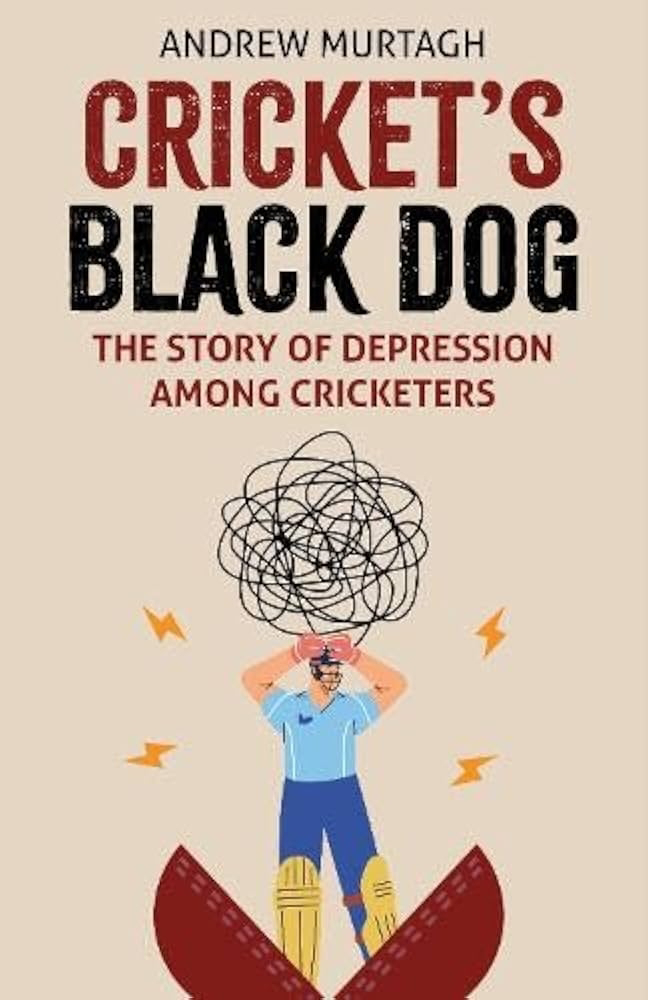
Book Review: Cricket's Black Dog: The Story of Depression Among Cricketers by Andrew Murtagh

I am of an age where I remember Andrew (or Andy as he was then known) Murtagh playing cricket. He wasn't a regular for Hampshire, but he was often enough in their teams for a young cricket fan like me to take note and file away the name for future reference..

Uncle of the long-serving Middlesex opening bowler, Tim, he was released by Hampshire in 1978, subsequently becoming a school teacher, then well-regarded writer and cricket historian. 

I had no idea when I watched him - why would I, any more than anyone else - that he was facing mental health challenges, that continued through his retirement. 

This book, like Luke Sutton's Back From The Edge which he often refers to, despite somewhat surprisingly admitting he had never heard of the former county stalwart, is not an easy read. How can it be, when it documents the challenges he has faced, his times in The Priory, the torment faced on at times a daily basis? 

There are studies of well-known former players who faced similar challenges throughout their careers, far too many taking their own lives when they could no longer cope with their life without the game. There is an especially good in-depth look at Wally Hammond, a troubled soul and largely unpopular man, despite being one of the greatest players to play the game. He seemed to change in personality after the tour of the Caribbean in 1925-6 and there appears little doubt that the treatment he received for syphilis at the time was a contributory factor. 

It is not new territory of course, the subject area covered admirably by David Frith in By His Own Hand, while David Foot revealed the real reason for Hammond's ill-health in his superb Wally Hammond: The Reasons Why.

The author doesn't come up with the answer to his central question - is cricket to blame, or are cricketers more susceptible to clinical depression? Perhaps input from clinical psychologists may have got him closer, or perhaps there is no one answer to the question. 

People's lives, circumstances and environments are all different and perhaps it is an unfortunate melting pot of these that causes someone, every now and again, to become the latest sad statistic.

What it should do, however, is again make supporters, especially those happy to anonymise their unpleasant output on social media, to be more aware of what they say. You never know the challenges faced by those that we watch, admire and hero worship, but a greater appreciation that they are no different to so many others would do no one any harm. 

This is certainly a book that is well worth reading.

Cricket's Black Dog: The Story of Depression Among Cricketers is written by Andrew Murtagh and published by Pitch Publishing

Monday, 26 May 2025

Book Review: Ten Drunks and a Parson: The Life and Times of Ted Peate by Ian Lockwood


I'm always a sucker for books on Golden Age and Victorian cricket and the people who played it. So when Ian Lockwood's book on Yorkshire spinner Ted Peate came in the post, it had a good chance of meeting with my approval.

It does not disappoint.

Admirably researched, it tells the tale of a man who emerged from the ninteenth century phenomenon of 'clown cricket' to become the country's pre-eminent left arm spinner - indeed, one described by WG Grace as the best in the world. He played in the first Test match, took over a thousand wickets in his ten first-class summers, yet was sacked by Yorkshire at the age of 35, dead ten years later.

Peate's problem, as the author explains in detail, was that he liked a drink. His many admirers wanted to buy him one and he found it hard to say no. Yet in that he was no different to most of his teammates. The book's title comes from how Lord Hawke was supposed to have described the under-performing Yorkshire side when he took charge in 1883. It was he who sacked Peate, yet it seems he was by no means the biggest problem in the side.

Peate's almost meteoric rise to fame and his slow fall to penury and premature death are very well captured by the author, whose research is as impressive as his writing. The book beautifully captures the age and the role of cricket, as well as painting vivid portraits of the incredible characters within it.

Peate was the first of a long line of outstanding left arm spinners in Yorkshire and can count himself unlucky that, although he lived a far from blameless life, he was the example that was made to 'encourage' the others. Bobby Peel, who replaced him in the Yorkshire side, gave far greater problems yet was tolerated for much longer by the man who released his predecessor. 

So why was he sacked, missing out on a benefit that would have made his retirement secure, even for a man not known for fiscal propriety? Perhaps Lord Hawke wanted an example made, his decision made easier by the presence of the younger Peel, a better bat and his supposed equal with the ball. That the latter was given far greater leeway adds fuel to that argument, but it did little for Peate and his wellbeing.

His remaining life was one of declining health and eyesight, still playing with success in club cricket, despite a widening girth, but aware that his plan for after the game, a sports shop in Leeds, was failing, with declining profits after his retirement. He died of pneumonia, a few days after being soaked on a trip to the theatre, in March 1900.

He lies in an unmarked grave in Yeadon cemetery, to the left of the runway at Leeds-Bradford airport. He is not alone in his last resting place being unmarked, as Derbyshire greats George Davidson and Bill Bestwick, among others, lie similarly unrecognised.

There's a worthy job to be done there, for all three. 

Speaking of worthy jobs, Ian Lockwood has done a fine one here, in a book that I heartily recommend. Likewise, Pitch Publishing have delivered another worthy title to their outstanding catalogue.

Ten Drunks and a Parson: The Life and Times of Ted Peate is written by Ian Lockwood and published by Pitch Publishing 

Thursday, 3 April 2025

Book Review: Sticky Dogs and Stardust: When The Legends Played The Leagues - Second Innings by Scott Oliver


Many years ago, when I first came to Scotland, I played for a few years in the then Scottish Counties cricket competition.

I played alongside a couple of professional cricketers. One of them had been a peripheral player at county level but was an excellent coach and improved my game considerably. The other was an Australian of some reputation, a wonderful player who seemed to score heavily every week, but had no idea how to explain to others what they needed to do to improve. Both were very good professionals, but experiences of other sides were varied, with their recruits lacking in one way or another, on or off the pitch.

Scott Oliver has followed his original book of the same title with another of similar quality. It is a rollicking read, choc-full of wonderful stories, players who left a lasting impression with their feats on the pitch and their 'talents' off it. Opening with Jesse Ryder, you get a very early idea of how the book is going to go and it is  hugely entertaining from cover to cover. I especially enjoyed the recounting of the Adrian Shankar tale, a player who was signed by Worcestershire on the back of his self-penned Walter Mitty-style press pieces, suggesting a player 'in the mould of Virat Kohli'..

As was the case with the first book, I was left in awe at the depth of research undertaken by the author, the number of people he has spoken to and the tales that he has unearthed. While it cannot be denied that any volume one will always contain the best subjects, this 'second innings' loses little in comparison. How could it, with the likes of Rohan Kanhai, Steve Smith, Chris Cairns, Abdul Qadir, Dennis Lillee and Joel Garner within its pages? 

I have no idea how blokes who worked in offices and factories all week prepared to face Michael Holding and Andy Roberts, or figured out the variations of Muttiah Muralidaran (as spelled here). But the stories of how they did so make this a book that should be in the bag of everyone heading to cricket matches this summer.

There will be lunch intervals and of course periods of rain. This book and its predecessor will be your best friends at that point. 

Every cricket fan needs these on their bookshelf. It is as simple as that. 

Sticky Dogs and Stardust: When The Legends Played The Leagues - Second Innings is written by Scott Oliver  and published by Fairfield Books

Sunday, 23 March 2025

Book Review: Deadly - Derek Underwood, The Life of an English International Cricketer by Mark Peel


A combination of one of the more reliable cricket writers and a cricketer who rarely let anyone down was always likely to produce a worthy tome.

So it follows that Mark Peel's biography of Derek Underwood is an outstanding read.

There was nothing flashy about the former Kent and England man. He went about his work with a familiar, trudging gait and was close to being a captain's dream. On any pitch offering help - and there were plenty in the 1960s, as tired old outgrounds were starting to slip below an acceptable standard - he was, as his nickname suggested, 'Deadly'. When conditions were less in his favour, his innate accuracy enabled him to slow down the scoring rate, giving little away to the greats of the game, many of who were playing county cricket at the time.

In that attitude he should have been a Derbyshire player and it was interesting to read that, when his involvement in World Series Cricket saw him initially sacked by Kent, he was approached by then Derbyshire captain, Eddie Barlow about a move to the County Ground.

It never happened, of course and Underwood remained a man of Kent until the end of his playing career. 

What a career it was. Almost 2,500 wickets at a shade over 20, with 297 at 25 in international cricket. The astonishing thing is that he was not always an automatic pick for his country. He wasn't strictly speaking a spin bowler and there were no real similarities between him and Norman Gifford, a fine but lesser bowler who was sometimes preferred. 

Critics said he bowled too quickly and was afraid to give the ball air, which was valid on a perfect pitch. Yet it also meant he was hard to get away and he could be relied upon to keep one end quiet, at least. 

His 7-50 against Australia on a rain-affected pitch at The Oval in 1968 earned England a draw in the series and set him off on an international career that saw him respected around the world. 

He appears to have been an admirable man too and those consulted in the excellent research for this book all bear testimony to a life well-lived. His friendly persona made him a popular host on cricket tours in later years and his passing last year was mourned throughout the game. 

This is an outstanding read, the latest in a long line from the publisher. My only grouse is that a career so spectacular was worthy of a statistical breakdown at the end. That apart, it is a book well worth the time and follows in a rich sequence of excellent volumes from the author. 

Recommended. 

Deadly: Derek Underwood, the Life of an English International Cricketer is written by Mark Peel and published by Pitch Publishing

Tuesday, 30 July 2024

Book Review: A Cricket Man: The Life and Loves of Steve Perryman

I have to be honest, when I first opened the package that had been delivered from Pitch Publishing, I thought I had been sent a book on football to review. 

With apologies, the first thought when I saw the name 'Steve Perryman' was of the former Tottenham midfield player, one who I enjoyed watching in my salad days.

Then I remembered the 'other' man of the same name and I started to read a book that is unusual, but all the more enjoyable because of that. 

The name may not be familiar with some people today, Perryman was a journeyman seam bowler for Warwickshire at a time when they had a good, but it is fair to say declining team. His tales of his playing days are enjoyable and they really bring home the challenges faced by professional cricketers. The end of his career, brought about by a combination of injury and poor coaching, is one that is experienced by too many and it certainly rung true to me about similar issues faced by Derbyshire players in my time as a supporter. 

Where the book really comes into its own is in his tales of the coaching techniques of the various coaches that he worked with. Bob Woolmer seemed to be a real thinker, a trend-setter, ahead of the game in discussing playing matches by the session. If you win more than you lose, you will do well. If you can't win the session, make sure you don't lose it and battle. John Inverarity is another who seems to have been a coach people wanted to work for, while others seem not to have been so advanced in their interpersonal skills. The tales are fascinating and having taken on board the best of these people, Perryman became a very well-regarded bowling coach, responsible for the development of Chris Woakes, among many others.

The other side of this book is the personal tragedy and how he came to terms with the loss of a beloved wife, then found love again in adversity. 

I really wasn't sure about the book when I started it, but it has been nicely put together, entertainingly written and Perryman comes across as a man I would really enjoy a beer with. Not least because we share very similar ideas on the way ahead for county cricket and the point at which it went wrong. He is a diehard Birmingham City supporter, but hey, we all have our crosses to bear...

It is not without error - I am not convinced Arthur Jepson  'is the only man to keep wicket for Nottinghamshire and goal for Lincoln City', because 'Jeppo' was a very good seam bowler who was also a near neighbour of ours in his later years. Yet this is a minor point and does not detract in any way from a book that should be essential for any fan of Warwickshire.

Or indeed for anyone who is keen to get their teeth into a very enjoyable book. 

Recommended.

A Cricket Man: The Life and Love of Steve Perryman'  is written by Steve Perryman, with Brian Halford.

Friday, 12 July 2024

Book Review: Faces on a Wall: An English County's Curious Collection of Captains by Andrew Radd


Over the course of my life, I must have read thousands of cricket books. I have a decent library of my own, but if I sat down and thought about it, my favourite ones cover the unsung heroes, people who in some cases have disappeared into the mists of time and are not household names. 

So it is with much of Andrew Radd's fascinating book on the many and varied characters who have captained Northamptonshire since 1878. 

I hadn't heard of many of the earlier ones, which made this book all the more enjoyable. There are a number of impressive names, including 'Tubby' Vials, Rawlins Hawtin and 'Punch' Raven. My knowledge kicked in around the time of Vallance Jupp and subsequently Freddie Brown, cricketers and characters both.

Like Derbyshire, Northamptonshire have seldom ascended the peaks of county cricket and for many years they were seen as the ultimate in perennial underdogs. Yet that changes nothing in so far as their contribution to the county game is concerned. Many outstanding players have played for them, and, as this book shows, a good few have been captain.

Dennis Brookes was an outstanding player for them either side of the Second World War and would have been an England regular had he played for a different county. Raman Subba Row became a respected administrator of the game, Keith Andrew was perhaps the best wicket keeper In the country through the 1950s and early 1960s, as well as being one of its great characters. 

Then there was Jim Watts, the very astute captain who led the county to one day silverware, Allan Lamb, Rob Bailey, Matthew Hayden.. the list goes on. 

A lot of work has gone into gathering together the information that makes this such an informative and enjoyable read. I respect that, because not all of that information would have been readily available in the public domain.

The book looks at the challenges faced by all of those captains as the game changed and it was no longer a necessity that an amateur should be in charge. 

While it is essential reading for any Northamptonshire fan, I can only say that any cricket fan will get to the end of this book and probably want to revisit it almost immediately. 

A very good read and again, massive respect to Pitch Publishing for ensuring this saw the light of day.

Faces On A Wall: an English County's Curious Collection of Captains is written by Andrew Radd

Wednesday, 5 June 2024

Book Review: Getting Out by Jonathan Campion


Before reading this book, I had no idea that cricket was played in Ukraine. 

Yet by 2020 there were 2,000 Ukrainians playing regular cricket, much of it down to a South African named Kobus Olivier, who had travelled the world as player and coach before settling in the Ukraine in 2018. 

An opening bat not quite good enough to do it for a living, he had fielded as 12th man for Western Province, Derbyshire and Kent in the 1980s before becoming a teacher.

Ending up in Ukraine, he encouraged private schools in Kyiv to put cricket on the curriculum and it took off, in a manner that reminded me of my introducing cricket to a state school in Scotlsnd in the 1980s - batting in the centre circle of football pitches.

This is a complete history of cricket in the country. With eyewitness accounts of the start of the war with Russia, the book manages at the same time to be heartening and sad. There are many light-hearted stories, including the team where no one in it wanted to bat or bowl, yet the final chapter, a guard of honour of sports people who have died in the ongoing conflict, shows the sad reality of life in that country.

A recognised national team from it may never take the field, but they were taken to the brink by individuals whose love of the game took it into new areas. 

You might not look at this book as your first choice of cricket reading. But you will be very pleased if you do. 

I finished it feeling inspired and motivated. That is quite an achievement, for any book and any author. 

Jonathan Campion has done a sterling job here and again Pitch Publishing are to be applauded for getting this book into print. 

Getting Out: The Ukrainian Cricket Team's Last Stand on the Front Lines of War is written by Jonathan Campion and published by Pitch Publishing


Saturday, 18 March 2023

Book Review: Gilly - The Turbulent Life of Roy Gilchrist by Mark Peel


When I saw that a biography of Roy Gilchrist was among Pitch Publishing's output for this Spring, I was excited.

I had heard a lot about the West Indian fast bowler over the years. Most of it, to be fair, erred on the side of 'nasty and unpleasant', while some offered balance and said that he was 'a nice guy when you got to know him and probably when he was on your side.'

Which is pretty much what comes out of this excellent biography by Mark Peel, an established cricket writer of some reputation.

Gilchrist appears to have gone through much of his life with a chip on his shoulder and a dislike of authority. There was a short fuse, that manifested itself on many occasions, not just on the cricket field.

It is hard to feel a great deal of sympathy for a bowler whose response to a batsman hitting him for four would frequently, all too frequently, be a beamer. That he never did anyone serious damage with such a delivery, bowled  at the pace that he did for many years, was a minor miracle. That he felt the need to do it against amateur cricketers in the Northern Leagues for many years was disappointing. 

The truth of the matter is that Gilchrist, had he focused on his devastating yorker, which got him most of his wickets, perhaps interspersed with an occasional bouncer, might have been a more effective player and more likeable to boot.

His devastating fallout with the then West Indian captain, Gerry Alexander, saw a premature end to his international career, which might otherwise have seen him regarded as one of the greats. As it was, he had to resign himself to a couple of tours, one of them to England in 1957, when some very good batters found him uncomfortably fast.

That some league cricketers managed to score runs against him spoke volumes for their techniques, as well as their bravery. There are countless tales of broken bones, cracked skulls and bruised thighs, not to mention numerous clashes with opponents, captains and many in positions of authority.

It is impossible to read this book with too much sympathy for Gilchrist. His temper was too quick, his attitude too questionable and his patience too short for that. Neither then nor now can his 'branding' his then wife with an iron during a row be excused, nor is it easy to feel sympathy for someone who showed little remorse for the damage that he inflicted on the cricket field.

Bowling bouncers at teenagers in friendly matches, as well as fast yorkers in charity games was not the sign of a competitive edge. Rather that of a bully and high level of petulance.

His end came after his return to Jamaica, when cricket could no longer provide a source of regular income. He was a man who perennially struggled with money and it went through his fingers too quickly, even - perhaps especially - in his salad days.

Yet there were those who claimed he was misunderstood, a gentle soul and a good teammate. I suspect the opinion of those who played with and against him was never indifferent, Gilchrist perhaps the epitome of a 'Marmite' cricketer.

We will not see his like again and that can only be a good thing. That he filled cricket grounds on the basis of his reputation is undeniable. Yet some time before the end of the book, the numerous  transgressions had tipped the scales of this reader to have little sympathy for a man who clearly had very little to give himself, at least until his more mellow, illness- ravaged decline.

This book is another terrific read, one that I got through in just a couple of days. It deserves to be successful and I suspect that it will be.

Yet again, Pitch Publishing have done an excellent job

Gilly: The Turbulent Life of Roy Gilchrist is written by Mark Peel and published by Pitch Publishing

Sunday, 5 March 2023

Book Review: How To Be A Cricket Fan: A Life in Fifty Artefacts by Matthew Appleby

The first cricket book that I have read in 2023 is by the experienced writer, Matthew Appleby. This is his seventh book and he is on sure ground with this biography, of his late father, Edgar.

In fact it is part biography, partly autobiographical and shows how the author grew up with a father who was cricket-mad, a serious collector of its memorabilia and literature, as well as a keen player, until age took its toll.

Each chapter focuses on a particular collectible and it is an engaging read. The book shows how the memorabilia and cricket collecting market has grown dramatically over his lifetime, the prices paid by his father seemingly good value in the modern era.

There are plenty of amusing anecdotes, as his father goes from cricket obsessive to being a renowned speaker and statistician of the game, getting to know many of those who played it and coming across as both a great character and a serious trencherman.

For many years he and his wife ran a bookshop in Keswick, as well as a market stall in the town. By the time I got to the end of the book, my overriding feeling was that I wished I had known this a few years ago, and I would have undoubtedly enjoyed a trip to the Lakes and some cricket purchases to complete the trip.

It is an enjoyable book and once again Pitch Publishing are to be commended for their willingness to publish a wide range of sporting books. Not necessarily those that guarantee huge sales, but ones where the tale deserves the telling. It will be of particular interest to the serious collector, although I have no means of verifying the values quoted for some of the items mentioned. 

I regard myself as a cricket fan and collector - certainly of Derbyshire-related material, but came to the conclusion that I am very much dipping a toe into the market, in comparison to Appleby senior.

I hope that the book does well. It is not without error, but I haven't read another like it and for that reason alone it made for a good read.

How To Be A Cricket Fan: a life in 50 artefacts is written by Matthew Appleby and published by Pitch Publishing, priced £18.99

Thursday, 11 March 2021

Book Review: Not Out At Close Of Play - Dennis Amiss with James Graham-Brown


It took several years of hard work for Dennis Amiss to cement a place in the Warwickshire side, yet he ended his career with 102 centuries and 212 fifties.

It took him many years to be seen as an international player, yet he ended his Test career with an average of 46, having played some memorable knocks along the way. The highlight was his mammoth, unbeaten 262 against the West Indies at Kingston, yet there was another double hundred against the keenest, nastiest attack in the world game to savour too. The latter came after he had been written off as someone who 'couldn't play fast bowling', rather making a mockery of the statement.

Like any other sportsman there were periods of famine, of course, but Amiss had enough high points to be regarded as one of England's finest post-war batsmen. Certainly, to his great pride, he ended his international career with a higher average than Colin Cowdrey or Tom Graveney, something which most would savour as an accomplishment.

This book was due for publication last year but Covid-19 saw it deferred to this one. I am grateful to The History Press for sending me a copy, as I love their cricket output and the subject's story was long overdue, despite an autobiography in the 1970s.

He was a player I enjoyed watching in my youth and what shines through from this excellent book, well-written by former Kent and Derbyshire all-rounder James Graham-Brown, is his innate modesty and humility. It wasn't easy to become a county player, nor to make it in Test cricket. Although he hinted at talent in his middle order days, it was only when he moved to open the innings that his career kicked into overdrive.

Maybe the nerves kicked in as he waited his turn to bat in a strong Warwickshire side, but moving to open alongside the burly John Jameson served the player and his county well. Perhaps an understatement, when one considers a career total in excess of 43,000 runs. 

The psychological side of cricket is nicely explored in this book. The transition of levels was not easy and like many others before and since he gave his wicket away too easily in his youth. When it clicked, he became a run machine, yet constantly worked at his technique to counter fresh challenges. 

He played in the Packer World Series against the greatest and fastest in the world, becoming a pioneer in the use of helmets in the process. He also went to South Africa on a 'rebel' tour, but again the rationale for doing so is clearly explained. The money on offer was too good to turn down and anyone with a family to support would likely have done the same.

Post-career Amiss has given many years of service to his beloved Warwickshire in off-field roles, including a long spell as Chief Executive Officer. He has served them admirably and is rightly revered as a county legend. He oversaw a period of county domination under Dermot Reeve, and covers subsequent drug scandals without ducking them. His insight into the signing of Brian Lara is fascinating, the signature on paper a day before he plundered England for 375 runs in Antigua. 

Amiss comes across as thoughtful, knowledgeable and witty, with a self-deprecating and dry sense of humour which makes reading it a joy. I especially loved the story of Indian spin legends Bedi, Prasanna and Venkat bowling to him on the edge of the square on the tour of that country in 1972-73, just to give him some practice. Not something one would see today! 

I would recommend this without question. It even comes with a foreword by Sir Geoffrey Boycott, a sign of respect if there ever was one.

Not Out At Close Of Play: A Life in Cricket by Dennis Amiss with James Graham-Brown is published by The History Press and available from all good book shops. 

Saturday, 7 November 2020

Book Review: The Life Of A Sports Agent - The Middleman by Luke Sutton


Agents eh? The ruination of sport and the root cause of many of its issues. They make loads of money, rip off their clients, don't really do that much and are perceived as 'sharks' by perhaps too many people for comfort.

And yet.. like any other profession there are a minority who tarnish the good name of plenty of others, working quietly and professionally under the radar. Like Luke Sutton, the former Derbyshire cricketer and captain. 

Regular readers will recall my review of his fairly harrowing first book, which dealt with his ultimately successful battles with his addictions. Many were oblivious to this in his playing days, just as there will be plenty who are unaware of the range of work involved in being a successful agent.

I am grateful to Luke for sending a copy of his excellent book to me ahead of its publication date at the end of this month. It is a really good read, full of relatable stories and names that will aid understanding of the work that agents do.

What impressed me most, as in his first book, is his honesty. He doesn't claim to have got everything right, freely admitting to mistakes along the way, but that is only natural. We are all human after all, but the detailed 'case studies' of his relationship with four very different clients are fascinating.

There are cricketers James Taylor and Jimmy Anderson, Olympic gymnast and social media star Nile Wilson and Olympic hockey gold medallist and now multi-faceted personality Samantha Quek, all profiled in detail alongside others, who flit in and out of the pages.

Each has enjoyed their time in the limelight but have faced challenges away from it. Taylor's heart condition that caused his premature retirement is well-documented, but hearing it from a man who first helped support him and then find a new career is fascinating. Equally so that of Wilson, who had it all yet could quite easily have lost it, but for support from his family and an agent who had 'been there' himself. Meanwhile Quek emerges as a shrewd and talented young woman, savvy enough to reject lucrative modelling offers so as not to distract from what she was really about, an articulate, personable and knowledgeable commentator on a range of sports, who was helped by an honest agent to escape the restrictive 'bubble' of hockey.

Luke's honesty and support will have been appreciated by all of them. It is not about signing lucrative deal after deal, it is being there for them in the bad times, advising them correctly on the many offers that come their way, being organised, understanding the media and working with them. Indeed, what impressed me was how his clients were encouraged to develop their interactions and profiles on social media and use it properly. 

'The highs are beautiful, but the lows can be very dark' he writes. By the end of the book I was left with the feeling that were I sufficiently famous I could work with someone like Luke. Friendly, accessible, supportive and seemingly calm under pressure, he has established a strong roster of clients and understandably so. 

The book is a must read for anyone thinking of such a career, but also for those who enjoy a different angle on sports, celebrity and the challenges faced by those perceived to have it all. 

Cricket fans will find much to enjoy, as the likes of Peter Moores, Haseeb Hamid, Tom Moores and plenty of others flit through the pages. Yet the real fascination for me was in seeing how Quek and Wilson, successful in niche sports, were helped to become broader and successful personalities outside of the sports that made their name. 

It deserves to do well and I would heartily recommend it to be added to your festive wish list. 

The Life Of A Sports Agent: The Middleman is written by Luke Sutton and published by White Owl, priced £12.99.

Available from all good book shops. 

Tuesday, 7 July 2020

Book Review: The Unforgiven - Mercenaries or Missionaries by Ashley Gray

I got to the end of this book with one thought in my mind.

That it is in the top half dozen cricket books of the thousands that I have read.

It really is that good. Not because it has two former Derbyshire players (Peter Kirsten and Lawrence Rowe) on the front cover, but because I have complete admiration for anyone who has put in the hard yards to get a book to publication. I compared it to my own experiences in writing In Their Own Words: Derbyshire Cricketers in Conversation. The hardest issue I found was in pinning down a suitable date for some interviews, the subjects almost without exception delighted to talk about their careers, the high and low points.

Australian writer Ashley Gray appears to have not enjoyed such luxury. He travelled to the Caribbean and to the United States in the hope of interviewing the West Indian players who went on the so-called rebel tours of South Africa in 1983/84. Some were happy to chat, others reluctant, a few decided against it after initially saying yes. There were requests for large amounts of money, and a hostility from some that is eye-opening.

The tours were well-intended, with the idea of showing that black players could compete as equals on the same pitch as their white counterparts. With South Africa excluded from the international fold because of apartheid, it was an opportunity for the best team in the world, the West Indies, to tour and perhaps open the door for a return.

Except it didn't work out that way. Although the squad that toured was a strong one, the very best players from the Caribbean didn't tour, even if several had first indicated that they would. It caused a rift of seismic proportions in West Indian cricket, with friendships lost forever at the same time as playing contracts. Most of those who toured never played in the West Indies again and certainly not for them. They became outcasts and a tour that was meant to be life-changing proved to be just that, but very much to the detriment of most members of the party.

Some did well. Lawrence Rowe, the tour captain left his native Jamaica and set up a successful vacuum seal business in Miami for three decades. The amount of money received for the tours was life-changing, but some were some were not prepared for it, spending it on fast cars, drugs and drink. For every Rowe and Albert Padmore there is a David Murray, once a highly-rated wicket-keeper, even if he spent much of his time on the pitch high on marijuana. He now spends his time selling drugs to tourists in Bridgetown, the physical deterioration sad to see. Then there is Herbert Chang, a talented batsman and Richard Austin, an all-rounder of genuine ability, both suffering from addictions and mental deterioration. The latter died in 2015, his slide from international all-rounder to shoeless street beggar a tragedy.

Or there is the supremely talented Bernard Julien, once regarded as the 'new Sobers' but distracted by his penchant for women and alcohol in equal measure and now battling depression and throat cancer. The author never did get his interview with him, despite travelling across the globe in order to do so. Nor with Colin Croft, whose curt 'I want nothing to do with you or your project' does little to change your mind on a gruff persona.

The overriding feeling is that the players were well-meaning but very naive. The volatility of their domestic setup was always going to leave them as persona non grata back home, despite their protestations to the contrary. It likely helped to some extent in South Africa, but their eventual reintegration into the international fold was to require a political swing that seemed unlikely at the time. For their many detractors, the tourists sold their reputations and dignity to extend the life of a disgraced government.

The cricket was competitive, as it was always going to be when two international juggernauts collided, but the financial reward for the tourists was tempered by reactions back home and even in the country, where a number of them encountered racism on their travels. They were looked after, treated as 'honorary whites' and entertained, they fathered a good few babies and enjoyed hospitality wherever they went. Yet the conclusion I drew is that few of them would make the same decision again, even if most were at best peripheral figures at international level, at the time of the tour.

A comparison with their English counterparts, who toured in 1982 and 1989, is valid. After a three-year Test ban most of the English tourists continued their careers in cricket, several reaching high office within the game's establishment or successful careers in the media or coaching. Those from the Caribbean, with the exception of Sylvester Clarke and Franklyn Stephenson, who had long county careers, effectively ended their cricketing lives with the tours.

The book is entertaining, harrowing and informative, beautifully written and researched by the author, whose first book is nothing other than a triumph.

Buy it or get it on your birthday or Christmas list. If you read better this year you will be very lucky.

The Unforgiven: Mercenaries or Missionaries is written by Ashley Gray and published by Pitch Publishing. It is available from all good book shops.


Friday, 7 June 2019

Book Review: Sense of Humour, Sense of Justice by Fred Rumsey

Fred Rumsey was a very good county cricketer. One good enough to play for his country in five Test matches, in which he took 17 wickets.

Bowling quick left arm, he represented first Worcestershire and then Somerset with distinction, taking 580 wickets between 1960 and 1969, at an average of 20 runs each.

He finished his career at Derbyshire, where he was a key member of the side that reached the Gillette Cup Final at Lord's in 1969.

I saw Fred a few times, although in his time at Derbyshire he was considerably slower and heavier than in his salad days. He wasn't picked for his fielding, which was functional at best and usually saw him at third man or fine leg, though in his prime he was a decent slip fielder. Nor for his batting, which was bucolic and entertaining for the short time that it usually lasted, Fred being a genuine number eleven. His bowling, however, was probing, accurate and a success. He is still the most economical bowler in the history of List A cricket, from those who bowled over 400 overs. 2.73 an over he went for, cheaper than van der Bijl, Cartwright and Garner... 

It was only ever a short-term signing, one brought about by his accepting the role of public relations officer with the club. He played from 1969 to 1973 for Derbyshire and did invaluable work towards the county's centenary celebrations in 1970. 

Indeed, whatever his merits as a cricketer, they were dwarfed by his off-field achievements. He single-handedly advanced the idea of a Professional Cricketers' Association, was very much a pioneer of public relations in the game and also played a leading role in the expansion of the Lord's Taverners.

His has been a life worth living and one in which he has had considerable fun. Funny stories are liberally scattered throughout the book's 256 pages, and although some of them are undoubtedly apocryphal, and others have had different people as the subject, they bear the retelling. The Derbyshire committee of the time does not come out of some of the tales especially well, but many around the circuit were renowned for being well meaning but amateur in the extreme at that time.
His career brought him into contact with many people, inside and outside sport and a rich array of character flit in and out of the chapters.

The book has many photographs and my particular favourite was one I had not seen before, of a Derbyshire v MCC match at Chesterfield in 1970, a game that featured a number of retired Derbyshire players.

It was a pleasure to read, not recording one of the game's true greats, but a fine player who made a greater contribution than most to its development. It is all the more rewarding for this. It is a lasting tribute to Fred, and also to Fairfield Books. The publishing house was set up by Stephen Chalke, one of my favourite cricket writers, and has produced some wonderful reads over the past twenty years.

This is but the latest of them.

Highly recommended.

Sense of Humour, Sense of Justice is written by Fred Rumsey and is available from Amazon and from all good book shops, priced £16

Saturday, 6 January 2018

Book Review: Over And Out - Albert Trott The Man Who Cleared the Lord's Pavilion by Steve Neal

One of the thrills of doing this blog over the years has been getting sent copies of cricket books for review by publishers. I have seen some that were less impressive, others that will stand the test of time.

This is one of the latter.

Albert Trott was one of the big names of golden age cricket. A man good enough to be picked to play five Tests in which he averaged 38 with the bat and 15 with the ball, took 26 wickets and was never picked again.

There were factions and rivalries to blame for his omission from the 1896 Australian tour to England, together with a feeling that he was a player of mercurial talent who suited himself, rather than the needs of the team. He liked to attack the bowling when he had a bat in his hand, but often did so before well set, to the detriment of his average. As a bowler he had the lot, bowled in a round arm style that could put in a fast one, just as easily as he would swing it or spin it when conditions suited him. He was not averse to buying wickets either when the batsmen prospered and he could be expensive. Yet in the variety of his skills he was a precursor of the modern one-day bowler, a format that would have suited him down to the ground

For around a decade he was a stand out player in the Middlesex side and a player that people came to watch. His reputation was made on a July day in 1899, when he hit Monty Noble of the visiting Australian side over the Lord's pavilion. He remains the only man to have done so, yet it perhaps summed up Trott's life that such a monstrous hit only counted for four under the rules of the day, the ball ending up in the garden of the house of a dressing room attendant, still within the confines of the ground. In that year and the one to follow, Trott scored over a thousand runs and took over two hundred wickets, figures that confirmed him as one of the giants of the age.

His batting deteriorated after this, attributed to his intent to replicate the feat. His batting became more that of exciting cameos, yet when he middled them, they continued to go a long way. His bowling was a force for some years, but a lifestyle in which he celebrated hard and enjoyed the drinks bought him by well-wishers affected his fitness and physique. In his early thirties, he could have been mistaken for someone 15-20 years older and while he still held catches that his team mates, a notoriously poor fielding side, would not have considered chances, his form was latterly elusive and he drifted from the game.

Trott took four wickets in four balls and then the hat trick in his benefit match in 1907, ending the match early as a consequence and robbing himself of a considerable amount of money. The latter proved elusive when his career ended, cricket having been his only life and interest. A spell as a first-class umpire was truncated when he suffered badly from dropsy, being admitted to hospital for fluid to be removed from his legs and his abdomen.

By 1914 he had had enough. Writing his will on the back of a laundry ticket and leaving his wardrobe and £4 in cash to his landlady, he shot himself in his bed and died immediately, aged only 41.

Contemporaries tell of a man who struggled away from the limelight and a circle of friends, or hangers-on, as we might call them today. A kindly man and a character, perhaps a little too fond of the drink for his own good and less willing to look after himself than others, who played for much longer at a time when players would continue well into their forties.

Trott was a very fine player, perhaps, for a couple of seasons, a great player of his time. He has been well served in this admirably researched and well written book by the author, who in turn has been treated well by Pitch Publishing. I would have liked to have seen a career record at the back, but that is a minor quibble.

You get to the end of this book knowing more about Victorian and Edwardian society and about Albert Trott, a flawed genius, but a man who entertained.

Not a bad epitaph, as they go.

Over And Out: Albert Trott - The Man Who Cleared The Lord's Pavilion is written by Steve Neal and published by Pitch Publishing. It is available from all good book sellers.

Sunday, 9 October 2016

Book Review: Test of Character: The Story of John Holder, Fast Bowler and Test Match Umpire by Andrew Murtagh

John Holder was the sort of journeyman professional who 'makes' the game of cricket.

His was not a stellar career, where he travelled the globe as a 'gun for hire' and made money in every continent. He had an in and out career for Hampshire, where he took 139 wickets over seven seasons, punctuating periods where he was out of form with occasional displays of brilliance.

Ironically, his best displays came in his final year on the staff, before a back injury ended his career. 13-128 in the match against Gloucestershire, followed by a hat trick against Kent. Afterwards he became a popular and successful professional in the Lancashire League.

'Popular' perhaps best sums up a man who was in the second wave of Caribbean immigrants recruited by London Transport after the war. While working on the Underground, he went for a trial with Hampshire who were so taken with his pace that they recruited him on the spot.

The book tells of his struggles on arrival in the country, trying to make a mark in the first-class game and his enjoyment of his professional and league career. It also tells of his popularity among supporters and team mates, a smile never far from his lips and always happy to talk to supporters and sign autographs. There have been plenty who were less willing over the years...

Then came umpiring, a job he fulfilled with considerable skill for 27 summers. There are plenty of tales from the circuit, as one might expect and it is the kind of cricket book I enjoy. We all know the stories around the biggest names, but it is a pleasure to get a different perspective from someone who became the first black man to officiate in a Test match in England.

Holder officiated in 11 Test matches and 19 ODIs and another claim to fame was in being the first neutral umpire in a Test series (Pakistan v India, for the trivia buffs).

It is a fine read, as befits the author, who has several strong titles to his name. I enjoyed Andrew Murtagh's biographies of Tom Graveney and Barry Richards, far bigger names, with respect, than John Holder.

Yet this was a tale that deserved to be told and who better to tell it than Murtagh, a former team mate of the player and best placed to write in an informed and, as usual, enjoyable manner. It is the story of a man, as well as that of an era on which many look back with considerable pleasure.

Heartily recommended and another fine title from Pitch Publishing

Test of Character: The Story of John Holder, Fast Bowler and Test Match Umpire is written by Andrew Murtagh and published by Pitch Publishing. It is available through all good book shops.

Thursday, 30 June 2016

Book Review: The Hard Yards: Highs and Lows of a Life in Cricket by Mike Yardy

Over the years I have written this blog, as regulars will know, I have always chosen my words carefully when talking about players and their form.

There are places on the internet where anything goes, from personal comments to harsh criticism that never seems to take account of one simple thing. That cricketers, like all of us, have things going on in their lives that sometimes make performing at their best a very difficult thing.

We have had our share at Derbyshire in recent years and the mental side of the game is huge. Even if you have the requisite technique or impressive statistics, there is always the niggle that you might not be good enough , might not be able to maintain standard and perhaps cannot deal with critics and their words.

This book is essential reading for anyone who has gone online and been critical of a sportsman or woman. It is also an outstanding read, as it reinforces the fact that even those at, or near the top of the tree have their insecurities. Some of them, big ones.

Like Mike Yardy. A member of a T20 World Cup-winning side and captain of a Sussex side that won two one-day trophies in 2009, yet tormented by self-doubt. Unsure of his talent, whether people believed in him and whether he could sustain his form, he sought help in 2011, when he should have been preparing for a World Cup quarter-final.

This is a fine and brave book, because Yardy was a cricketer that any side would love to have as a member. If this kind of thing can happen to him, how many others might this crippling depression affect? Lots actually, more than you might think and in an age when every ball, shot, drop or decision is scrutinised and commented on by all and sundry, not everyone can handle the pressure and the attention.

Now retired and studying for a degree in sports psychology, a career in which he hopes to help others deal with the highs and lows of professional sport, Mike Yardy can reflect securely on two things.

One, that he WAS a very good cricketer - you don't produce those statistics, nor make it to the level that he did, without being so.

Two that, with his collorator Bruce Talbot, he has produced one of the most compelling cricket books of recent times.

Do yourself a massive favour and buy it. It will open your eyes...

The Hard Yards: Highs and Lows in A Life of Cricket is written by Mike Yardy and published by Pitch Publishing. It is currently available at £18.99 as a hardback